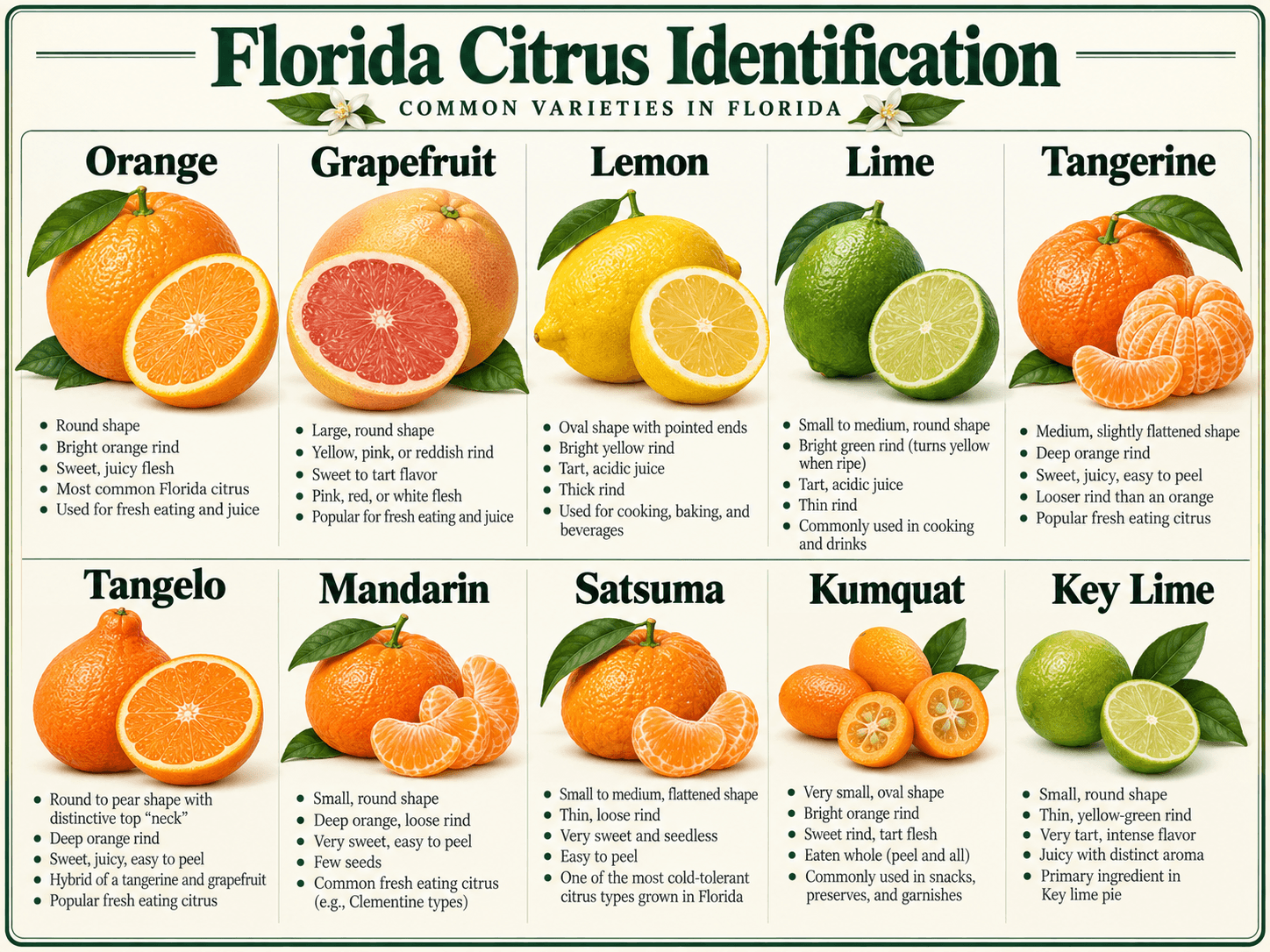
Rootstocks, commercial fruit and leaf identification. Study the photograph first, compare the field-guide illustration, then prove recall without the name visible.
42cards in this sectionUse recall mode when recognition feels easy.
Citrus picture and sketch guides
Switch between the color chart and the sketch companion. These are broad fruit overviews; the reference library also covers the exact cultivars, rootstocks, leaves, pests, disorders, and weeds.
AI-generated study illustration. Real specimen photographs and source-backed cultivar details remain in the identification cards.Important identification notes
Use shape, rind, internal features, and the complete specimen together; rind color alone is not enough.
Tangerines and satsumas are mandarin types, not ten mutually exclusive botanical groups. The strong neck on this tangelo illustration represents a Minneola-type form, not every tangelo.
The chart's seed, size, and flavor descriptions are generalizations. Do not use a generic red grapefruit drawing to identify Duncan or Marsh, or a fruit picture to identify a rootstock leaf.
Illustrated study aid. Illustrated fruit form, not a rootstock-leaf specimen. Color and seed count vary; do not infer an exact cultivar from a generic fruit drawing.
Fruit & leaves●
Sweet Orange
Look first
Round to slightly oval fruit; use peel, size, leaf and petiole together.
Fruit color alone is not enough because maturity and cultivar change appearance.
Compare against grapefruit, lemon and lime side by side.
Illustrated study aid. Illustrated fruit form, not a rootstock-leaf specimen. Color and seed count vary; do not infer an exact cultivar from a generic fruit drawing.
Fruit & leaves●
Grapefruit
Look first
Usually larger and broader than an orange.
Use relative size with peel texture and leaf traits.
Do not identify from size alone when specimens vary.
Illustrated study aid. Illustrated fruit form, not a rootstock-leaf specimen. Color and seed count vary; do not infer an exact cultivar from a generic fruit drawing.
Fruit & leaves●
Lemon
Look first
Often oblong with a noticeable nipple at one or both ends.
Illustrated study aid. Illustrated fruit form, not a rootstock-leaf specimen. Color and seed count vary; do not infer an exact cultivar from a generic fruit drawing.
Fruit & leaves●
Lime
Look first
Often smaller than lemon and round to oval.
Ripe limes may yellow, so green color is not a safe single clue.
Pair size and shape with leaf clues.
Memory cueLime = small citrus; don't trust green alone.
Start with the trifoliate leaf: three leaflets on one petiole, often with a noticeable winged petiole.
Closest checkCompare with Poncirus trifoliata and Swingle Citrumelo. Use leaflet size, petiole wings and fruit together instead of calling every trifoliate sample the same rootstock.
Contest habitname the visible symptom, structure or damage pattern before you name the item.
Memory cueCarrizo = trifoliate citrus hybrid; confirm the whole sample.
Confirm grapefruit size, then use the interior: Flame is a red-fleshed grapefruit with very few seeds.
Closest checkDuncan is white and seeded; Marsh is white and seedless; Ruby/Ray Ruby are also red, so flesh color alone may not identify the exact red cultivar.
Contest habitname the visible symptom, structure or damage pattern before you name the item.
Memory cueFlame = red grapefruit + low seed count.
Look for a round sweet-orange fruit with a smooth thin rind and no navel.
Closest checkWashington Navel has an obvious navel; Valencia also lacks a navel, so variety-level ID may require the labeled contest specimen or season/internal clues.
Contest habitname the visible symptom, structure or damage pattern before you name the item.
Memory cueHamlin = plain round sweet orange, no navel.
Illustrated study aid. Illustrated fruit form, not a rootstock-leaf specimen. Color and seed count vary; do not infer an exact cultivar from a generic fruit drawing.
Rootstocks, Leaves & Fruit●
Key Lime
Look first
Look for a small, round-to-oval lime with a thin rind; ripe fruit can turn yellow and is commonly seedy.
Closest checkPersian lime is larger and usually seedless, so size and seeds matter more than green color.
Contest habitname the visible symptom, structure or damage pattern before you name the item.
Illustrated study aid. Illustrated fruit form, not a rootstock-leaf specimen. Color and seed count vary; do not infer an exact cultivar from a generic fruit drawing.
Rootstocks, Leaves & Fruit●
Kumquat
Look first
Look for a very small orange citrus fruit, often oval, with a proportionally thick sweet peel.
Closest checkCalamondin is usually more round and reads like a tiny orange.
Contest habitname the visible symptom, structure or damage pattern before you name the item.
Memory cueKumquat = tiny orange fruit, often oval.
Confirm grapefruit size and inspect the cut flesh for a deep red color.
Closest checkRuby Red and Flame are also red grapefruit types; exact cultivar ID may require the official labeled specimen or additional internal traits rather than rind alone.
Contest habitname the visible symptom, structure or damage pattern before you name the item.
Memory cueRay Ruby = deep red grapefruit; don't trust rind alone.
Illustrated study aid. Illustrated fruit form, not a rootstock-leaf specimen. Color and seed count vary; do not infer an exact cultivar from a generic fruit drawing.
Rootstocks, Leaves & Fruit●
Satsuma Mandarin
Look first
Look for a distinctly flattened mandarin with a loose, puffy, very easy-peel rind.
Closest checkClementine is usually smaller and smoother/tighter; Murcott is tighter-skinned.
Contest habitname the visible symptom, structure or damage pattern before you name the item.
Look for a round-to-oval sweet orange with a thin smooth rind and no navel.
Closest checkHamlin and Pineapple orange can look similar; use the full official specimen and internal/season cues rather than claiming an exterior-only ID.
Contest habitname the visible symptom, structure or damage pattern before you name the item.
Memory cueValencia = smooth late orange, no navel.